Asphalt in Lake County, Florida takes a beating that most of the country never sees. Between the summer humidity pushing 80%, afternoon downpours that can drop two inches of rain in an hour, and UV exposure that rivals anywhere in the Southeast, your commercial parking lot is under constant assault. Ignoring it costs far more than maintaining it. Contact Reliable Pavement Maintenance at (407) 924-8228 to schedule an assessment before the next storm season hits.
How Does Lake County's Climate Damage Commercial Asphalt?
Lake County's heat and humidity combination accelerates asphalt breakdown faster than the national average. Summer temperatures regularly exceed 95°F on the pavement surface, and the near-daily moisture cycle causes the asphalt binder to soften, harden, and crack in ways that wouldn't happen in drier climates. Sandy soils throughout the area, from Leesburg to Tavares, also shift more readily than clay-heavy soils, which puts added stress on the base layer underneath your lot.
In our 40+ years serving Central Florida businesses, we've seen unprotected parking lots lose 30% to 40% of their usable lifespan simply because sealcoating was deferred by a single season. A lot that should last 20 to 25 years can degrade to the point of needing full replacement in 12 to 15 years without routine care. That replacement can run $3 to $7 per square foot, compared to routine maintenance costs of $0.15 to $0.25 per square foot for sealcoating. The math isn't complicated.
What Happens to Asphalt When Florida Rains Hit Unprotected Pavement?
Florida's afternoon rain events are short, intense, and relentless from June through October. Water that sits on or penetrates an unsealed surface works its way into the sub-base, softening the material that holds everything together. Once the base weakens, you get depressions, potholes, and full base failure.
This is one of the most common problems we see on commercial lots in Clermont and Leesburg, particularly in older retail centers and office parks where the original sealcoating was never refreshed. By the time potholes appear, you're no longer dealing with a surface repair. You're looking at base reconstruction, which can run $5 to $15 per square foot depending on how deep the damage goes. Catching base weakness early, before hurricane season, means you're spending a fraction of that on crack filling and patching instead.
Our asphalt repair and sealcoating services address these issues at every stage, from preventive treatment to full-depth repair.
Why Does Sealcoating Matter for UV Protection in Central Florida?
Sealcoating protects asphalt from intense UV rays the same way sunscreen protects skin from sunburn. Without it, UV oxidation breaks down the asphalt binder, turning your lot gray and brittle within three to five years of installation. Once that oxidation sets in, the surface starts to ravel, meaning the aggregate loosens and the pavement begins to crumble from the top down.
A fresh coat of spray sealcoating blocks UV rays, repels water and oil, and restores the rich, dark appearance that signals a well-maintained property to your customers and tenants. Industry experts recommend resealing every two to five years, depending on traffic volume and exposure. High-traffic commercial lots near State Road 50 in Clermont or US-441 in Leesburg typically fall on the two- to three-year end of that range.
Sealcoating also fills minor surface voids that would otherwise collect water, accelerating freeze-thaw cycles in the rare Florida cold snaps or simply holding moisture against the binder long-term.
Does Parking Lot Striping in Lake County Affect Safety and Compliance?
Precise parking lot striping in Lake County, Florida, directly affects ADA compliance, fire code clearance, and customer safety. Faded or missing markings create liability exposure for property owners and make your lot harder to use. That translates into a worse customer experience before anyone ever walks through your front door.
Clearly marked stalls, properly dimensioned ADA-accessible spaces, directional arrows, and fire lane markings are not optional for most commercial properties. ADA requirements mandate specific stall widths, access aisle dimensions, and signage that many older lots don't meet without an updated striping layout. When a customer in a wheelchair can't access your building because the access aisle is missing or faded, that's both a compliance issue and a customer service failure.
Reliable Pavement Maintenance handles full parking lot striping layout, re-striping, and ADA compliance review for businesses throughout Lake County. We'll design the layout to control traffic flow, maximize stall count, and meet all applicable local and federal requirements.
When Should You Fill Cracks Before Hurricane Season?
Fill cracks as soon as you spot them, ideally before June 1, when hurricane season officially begins. Any crack wider than a quarter-inch is an entry point for water. Once water gets into the crack, it weakens the base material below, and the hydraulic pressure from heavy rain events pushes that damage deeper and wider. A crack that costs $1 to $3 per linear foot to fill in March can become a pothole repair costing $200 to $500 per spot by September.
Hot crack filler bonds directly to the asphalt edges and remains flexible through Florida's temperature swings. Cold crack filler works well for smaller, hairline cracks. The right product depends on the crack width and the age of the surrounding pavement. We assess both before recommending a treatment approach.
Spring is the best time to schedule this work across Lake County. You avoid the daily afternoon storms that can interrupt curing, and you get ahead of the storm season window before the ground saturates.
Why Does Hiring a Local Contractor in Central Florida Actually Matter?
A contractor who doesn't know Central Florida's soil conditions and climate patterns will apply the same approach they'd use in Atlanta or Charlotte, and it won't hold up the same way. Lake County's sandy soils shift differently under load than the clay-heavy soils common further north. That affects base prep, drainage slope requirements, and how aggressively you need to address edge cracking.
Local knowledge also means knowing which products perform under sustained high humidity, which sealers maintain adhesion on oil-spotted surfaces common in high-traffic retail lots, and how to schedule work around Florida's afternoon storm windows to protect curing time. An out-of-region crew won't price that risk appropriately or schedule around it the way a local team will.
Reliable Pavement Maintenance, Inc. has served Lake County and surrounding Central Florida communities for over 40 years. Our team works on everything from small medical office lots in Tavares to large retail centers across the county. We know the ground conditions, the weather patterns, and the local code requirements that affect every job we take on.
Building a Long-Term Maintenance Schedule That Protects Your ROI
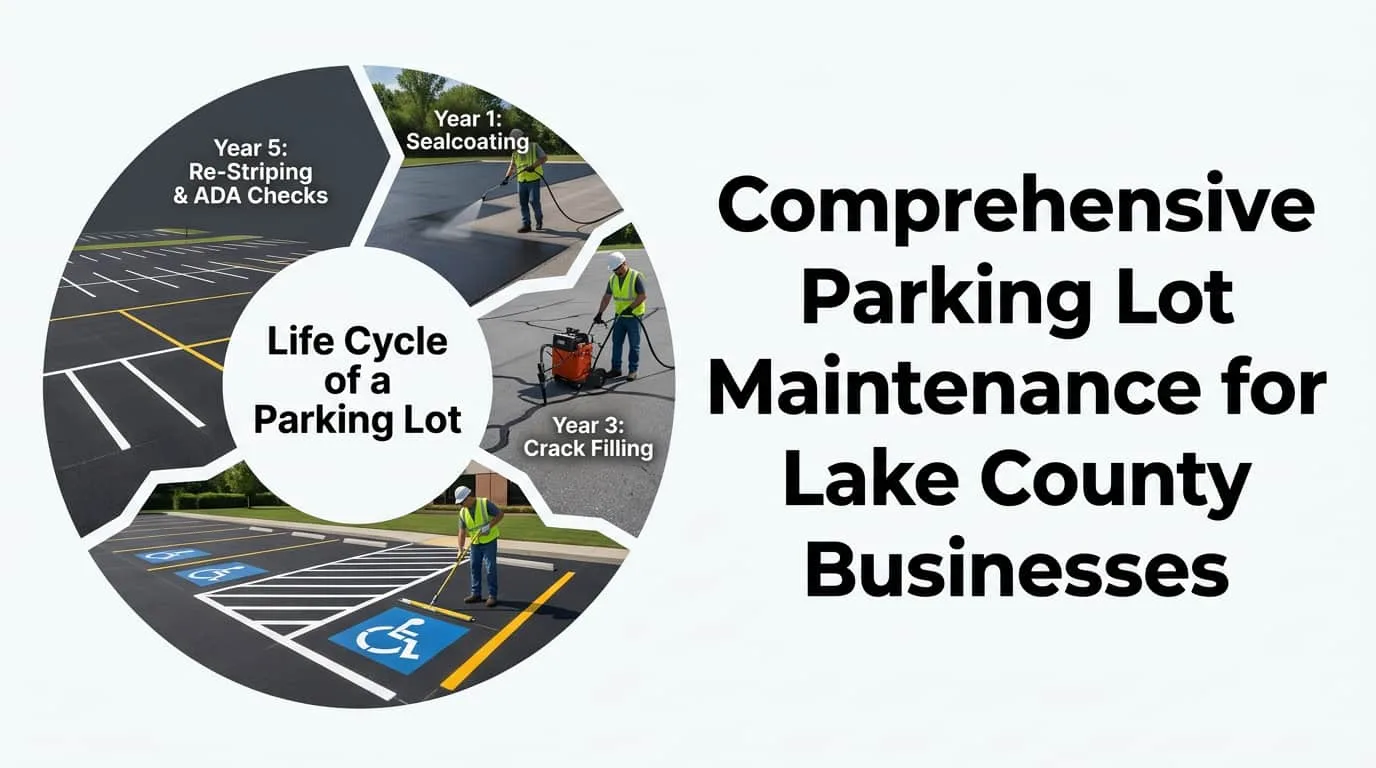
A long-term maintenance plan isn't complicated, but it does require consistency. Here's a general framework that works for most commercial lots in Lake County:
- Year 1 to 2: Inspect and seal any cracks that appeared during the first rainy season. Document baseline pavement condition with photos.
- Year 2 to 3: Apply first sealcoat treatment. Re-stripe the full lot. Verify ADA compliance on stall layout and signage.
- Year 4 to 5: Inspect for base issues, localized potholes, and edge deterioration. Spot-repair as needed. Apply second sealcoat if the surface shows signs of oxidation or graying.
- Every 2 to 5 years, ongoing: Resealing cycle based on traffic volume and condition assessment. Re-stripe whenever line visibility drops to a level that affects traffic flow or compliance.
A well-maintained lot can realistically last 25 years or more before needing full removal and replacement. Lots without any scheduled maintenance typically show significant structural problems in 10 to 12 years. The cost difference over that timeline is substantial.
Get Your Lot Assessed Before the Next Rainy Season
Your parking lot is often the first thing your customers and tenants see. A cracked, faded, or poorly marked lot signals neglect, and that impression doesn't stay in the parking lot. Staying ahead of Florida's weather with a consistent maintenance plan protects your investment, keeps your property compliant, and avoids the much larger expense of premature replacement.
Contact Reliable Pavement Maintenance at (407) 924-8228 to schedule a free estimate. We serve businesses throughout Lake County, including Leesburg, Clermont, Tavares, and the surrounding Central Florida area.