· by Hanna Carolina · 5 min read
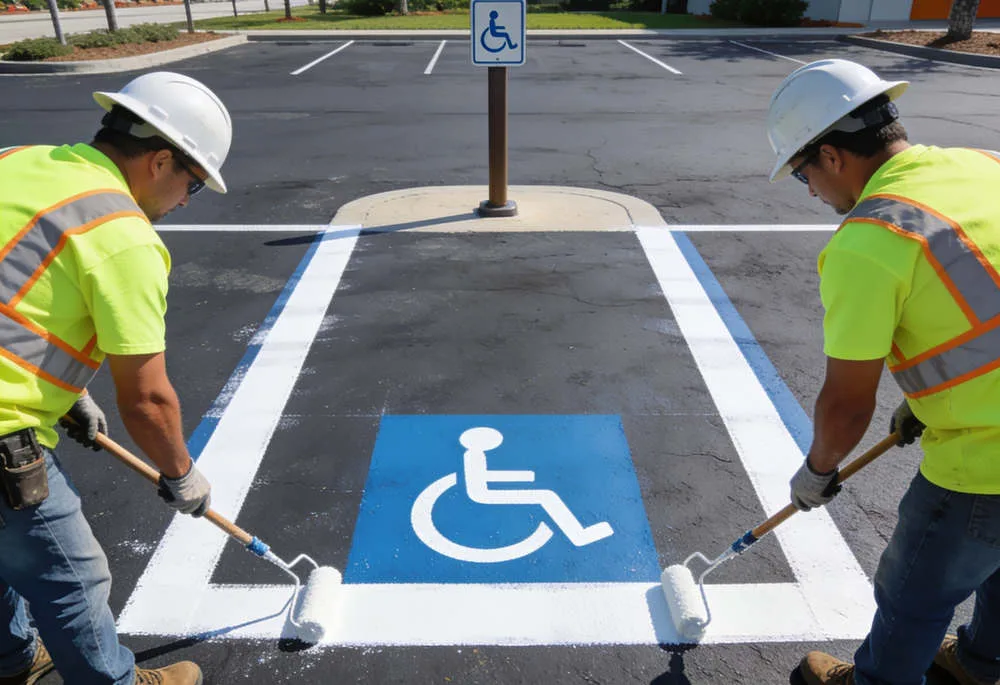
A faded accessible parking space is not just a maintenance issue. It is a compliance gap that exposes a property to ADA complaints, civil litigation, and regulatory action, regardless of whether the original striping was correct when applied. Paint fades. Requirements persist. Commercial property managers who wait until striping becomes invisible before addressing it are managing liability reactively rather than proactively. Reliable Pavement Maintenance combines sealcoating, striping, and ADA-compliant layout in one coordinated visit, so Lake County properties can close those gaps efficiently. Request a free compliance walk-through from Reliable Pavement Maintenance or call (407) 924-8228 to find out where your lot stands.
What faded striping actually means for liability
Commercial properties in the Clermont area along U.S. 27 carry significant foot traffic, and accessible parking enforcement in Florida is active. An ADA complaint does not require a physical injury. A person with a disability who is denied equivalent access because spaces are unmarked, improperly laid out, or missing required signage has grounds for a federal complaint under the Americans with Disabilities Act. State law adds another layer. The combination means that a lot with deteriorated striping is not merely out of aesthetic shape; it is out of legal compliance, and the cost of defending or settling a complaint almost always exceeds the cost of the striping work that would have prevented it.
Retail and medical properties near the historic downtown in Mount Dora face a version of this that property managers sometimes underestimate. A lot that was correctly striped when originally built may no longer be compliant if a sealcoating cycle buried or distorted the original lines, if the van-accessible space lost its access aisle markings over time, or if signage posts were removed or damaged and never replaced. Compliance is not a one-time achievement. It requires that the visible, on-the-ground conditions match the requirements at any given inspection.
Leesburg's commercial corridor along U.S. 441 illustrates another common gap: lots that have the right number of accessible spaces but are missing the required access aisles, the hatched no-parking zones that allow wheelchair deployment beside the vehicle. An accessible space without a properly marked access aisle does not meet the standard, even if the blue paint on the space itself is fresh.
What compliance actually requires on the ground
The specific requirements are detailed in the ADA Standards for Accessible Design, and property managers are responsible for understanding them as they apply to their lot's size and use. Without citing exact code minimums as guarantees, the categories that most often generate violations in commercial lot inspections are:
- Accessible space count relative to total lot capacity, including van-accessible spaces within that count
- Access aisle width and markings adjacent to each accessible space, with van-accessible aisles meeting a wider minimum
- Signage mounted at the correct height and displaying the correct symbol, with van-accessible spaces carrying an additional designation
- Surface condition of accessible spaces and aisles, which must be stable, firm, and slip-resistant with no significant cross-slope
- Accessible route from the accessible spaces to the building entrance, unobstructed and correctly surfaced
Any one of these categories can create a compliance failure independent of the others. A lot that has the right number of spaces but incorrect signage height is still non-compliant. A lot with correct signage but faded or missing access aisle markings is still non-compliant.
How a seal-and-stripe project closes the gap efficiently
The most cost-effective time to address ADA striping is during a spray sealcoating cycle. The lot surface is being prepped and recoated anyway, which means the old striping is being covered and new lines must be applied regardless. Incorporating a full ADA-compliant layout into that restriping adds minimal cost compared to scheduling it as a standalone project, and it ensures the new lines are applied over a fresh, uniform surface rather than over faded or patchy existing paint.
A practical example: a retail lot in Lake County with twenty parking spaces and two accessible spaces, one of which has lost its van-accessible designation sign and both of which have faded access aisles. A phased seal-and-stripe project sections the lot into two halves, keeping half open while the other is sealed and restriped over two days. When complete, both accessible spaces have fresh markings, correctly sized access aisles, properly mounted signage, and a documented work order showing the date of service. That documentation matters. It is the paper trail that demonstrates proactive compliance management if a complaint is ever filed.
Pavement condition and ADA compliance are connected
The ADA requirement for stable, firm, and slip-resistant surfaces applies directly to accessible spaces and routes. Asphalt that has deteriorated to the point of significant cracking, surface raveling, or ponding water in accessible areas creates a compliance exposure that striping alone cannot resolve. A lot assessment identifies whether the surface condition in accessible areas meets the standard or requires repair before restriping is meaningful.
If your Lake County or Orlando commercial property has not had a compliance walk-through in the past two to three years, the free assessment is the right starting point before another sealcoating cycle begins. Call Reliable Pavement Maintenance at (407) 924-8228 or schedule your free ADA compliance walk-through with Reliable Pavement Maintenance and get a documented picture of where your lot stands.