· by Hanna Carolina · 5 min read
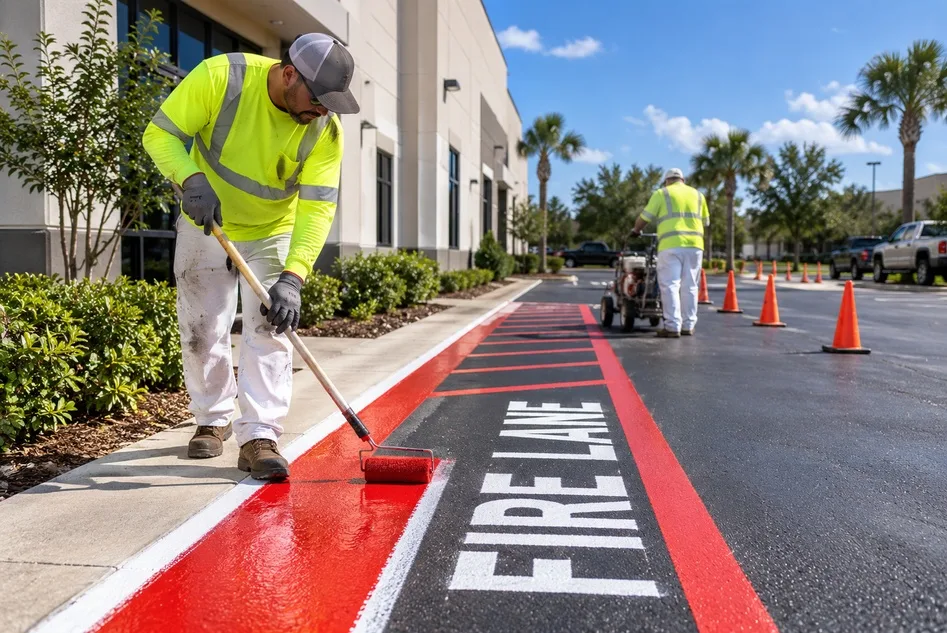
Passing a fire lane inspection comes down to three things: the right color, the right lettering, and markings placed exactly where the approved site plan and your local fire marshal say they belong. Faded paint, missing stencils, or a fire lane that drifts away from the curb line are the most common reasons a property gets written up.
Good parking lot striping is not just about neat lines. It is about passing inspection the first time and keeping deliveries moving. At Reliable Pavement Maintenance, we lay out fire lanes and loading zones to the standard your inspector expects, not to what the old faded lines used to show. If you have an inspection coming up, or just failed one, call our striping crew at (407) 924-8228 and we will help you get ahead of it.
What color and lettering does a fire lane need in Lake County?
Most Florida fire lanes use yellow curb paint and yellow "NO PARKING FIRE LANE" lettering on the pavement, backed by posted signs. The exact details are set by the fire official with jurisdiction over your property, under the Florida Fire Prevention Code.
That last part matters in Lake County, because the fire marshal reviewing your lot may be with Lake County Fire Rescue or with a city department such as Clermont or Leesburg, depending on where the property sits. Standards are similar, but the details can differ. A common Florida requirement calls for lettering at least 6 inches tall, repeated about every 25 feet along the lane, with the curb painted solid yellow. Some jurisdictions also want diagonal hatching where a former parking space has been converted to fire lane, plus signs at set intervals.
Before any paint goes down, we confirm the requirements with the approved site plan or the inspector's notes. Guessing is how a lot ends up striped twice. If your lot was originally striped years ago, the current fire lane layout may not even match what the code expects today, and that is worth catching before an inspection rather than during one.
How should loading zones and no-parking areas be marked?
Loading zones should be marked clearly enough that a driver understands, at a glance, that the space is not for parking. That usually means yellow hatching or a bold outline, a "LOADING ZONE" or "NO PARKING" stencil, and a posted sign that matches the paint.
Visibility is the whole point. On busy strip centers along US-27 in Minneola and Clermont, where customers circle for the closest space, a faded loading zone simply looks like an open spot. Drivers park in it. Delivery trucks then double park, block a drive aisle, or leave without unloading. That is a business problem, and if the truck ends up in a fire lane, it becomes a compliance problem too.
We worked with a Lake County shop owner who was dealing with exactly that. Their loading zone striping had faded so badly that customers kept parking there, and delivery trucks could not get in to make the drops the business depended on. Faded paint like that does not just look tired. It costs a business deliveries. No-parking zones near dumpster enclosures, building entrances, and drive-throughs need the same treatment, because a marking nobody can see protects nobody.
What curb painting and stencil standards should you expect?
Curbs should be cleaned, dry, and painted with a solid, even coat of traffic paint across the top and face. Stencils should be uniform in size, square to the lane, and placed so approaching drivers can read them from the direction they travel.
Prep is what separates a professional job from a quick one. Curbs collect dirt, mildew, and loose old paint, especially under the shade trees common around older lots near downtown Mount Dora. Painting over that grime means peeling within months. We pressure wash or brush the curb, let it dry, then apply paint in even coats so the color reads clearly from a distance.
Stencils need the same care. Letters that are crooked, uneven, or upside down to oncoming traffic look careless, and inspectors notice. We measure and snap layout lines before stenciling so spacing stays consistent the full length of the lane. Striping also holds up best on sound pavement, so if your surface is cracked or crumbling, it is worth addressing the asphalt first so new markings are not laid over damage.
How does correct parking lot striping layout help you avoid citations?
Correct layout means the markings match the approved site plan and the fire official's requirements from the start, so the job passes inspection once. Every rework trip costs money, and a failed inspection can mean a re-inspection fee and a deadline to correct the problem.
The costly mistakes are usually small. A fire lane stenciled in the wrong spot. Lettering too short. A loading zone that blocks a required fire lane. A converted parking space that still looks like a parking space. Each one can mean grinding or blacking out paint, restriping, and scheduling another inspection, all while your tenants deal with the disruption twice. Getting the layout right before the paint truck shows up is cheaper than any of that.
Need parking lot striping for fire lanes and loading zones that passes the first time? Call Reliable Pavement Maintenance at (407) 924-8228, or request a striping estimate, and we will make sure your Lake County property is marked right.