Non-compliant ADA striping puts your Central Florida property at serious legal and financial risk. A single ADA violation can result in fines starting at $75,000 for a first offense. If you manage a commercial property in Lake County or the surrounding region, getting your parking lot striping right isn't optional. Contact Reliable Pavement Maintenance at (407) 924-8228 to schedule a compliance review before your next inspection.
Florida's heat, heavy rain, and strict local codes make ADA-compliant striping a moving target. Markings that looked sharp 18 months ago may already fall below the visibility threshold required by Florida statute. This guide walks you through exactly what compliance looks like, why it matters for your property, and how to stay ahead of it.
What Does Florida's ADA Accessibility Code Require?
Florida's ADA accessibility requirements go beyond the federal ADA Standards for Accessible Design. The Florida Accessibility Code, adopted under the Florida Building Code, adds specific local provisions that property managers must meet on top of federal minimums. That means following only the federal guidelines isn't enough to protect your property from liability.
Florida requires accessible parking spaces to be at least 12 feet wide for standard accessible stalls and 11 feet wide for van-accessible stalls with an adjacent 8-foot access aisle. Van-accessible spaces require a minimum vertical clearance of 98 inches throughout the route from the accessible entrance to the vehicle. The Florida Building Code also mandates that all accessible routes connect directly to the public right-of-way, which affects how your lot's layout, curb cuts, and crosswalks must be configured together. Getting any one of these elements wrong puts you out of compliance across the board.
What Does a Compliant Parking Lot Actually Look Like?
A fully compliant parking lot in Central Florida has several distinct elements working together. Miss one, and you're exposed.
Stall count: The number of accessible spaces you need depends on total lot size. A lot with 1 to 25 total spaces requires at least 1 accessible space. Lots with 26 to 50 spaces need 2. The count scales up from there, with 1 van-accessible space required for every 6 accessible spaces.
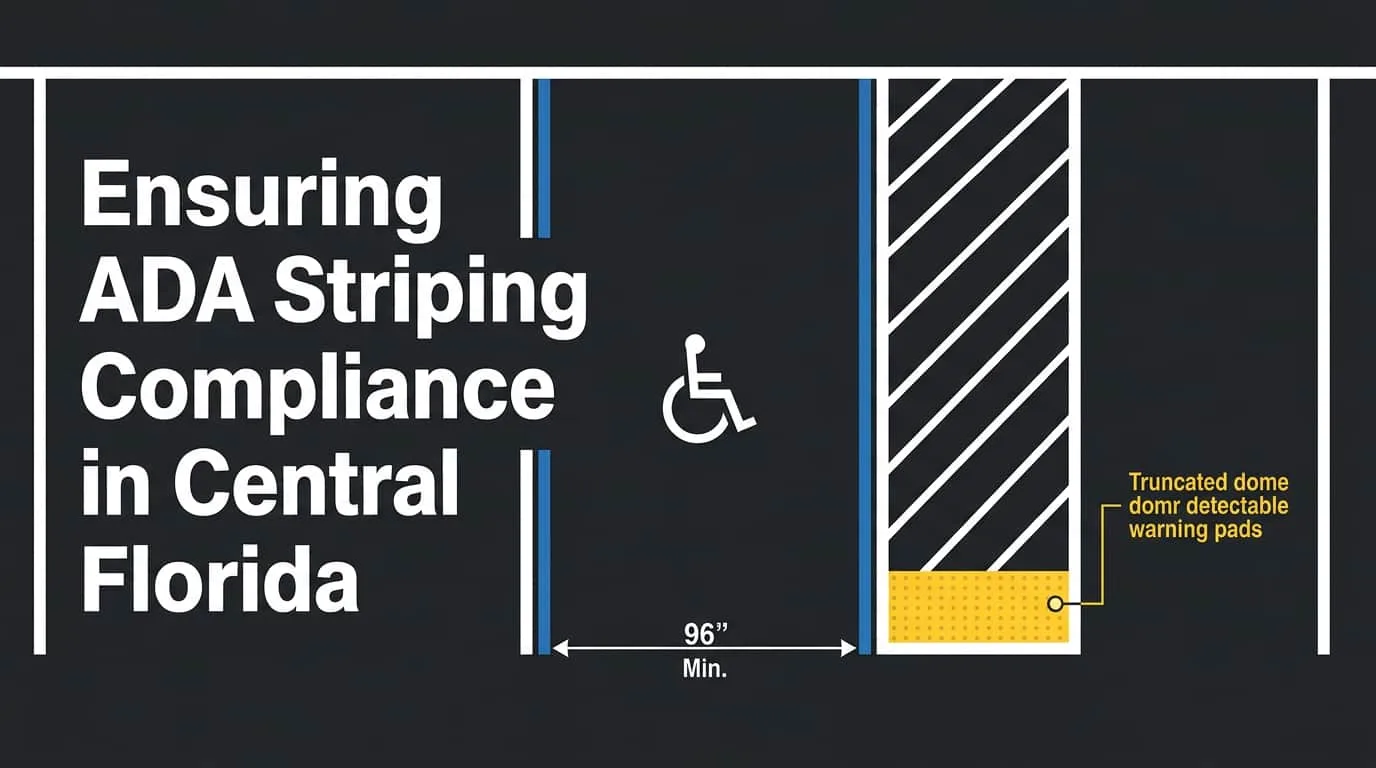
Access aisles: Every accessible stall must have a marked access aisle directly adjacent to it. Standard aisles are 60 inches wide. Van-accessible aisles are 96 inches wide. These aisles must be marked with diagonal blue-and-white striping and the words "NO PARKING" in white paint to prevent drivers from treating them as overflow spaces.
Pavement markings: Florida requires the International Symbol of Accessibility painted in white or blue on the stall surface. The symbol must be at least 36 inches tall. The blue-and-white color combination is the state standard, and markings must maintain strong contrast against the asphalt surface. Our team at Reliable Pavement Maintenance sees faded symbols regularly on lots that haven't been restriped within the past two to three years.
Detectable warnings: Truncated dome surfaces are required at all curb ramps connecting accessible routes to vehicle areas. Florida code specifies that these domes be federal yellow to contrast against the surrounding pavement.
Why Does Florida's Climate Make This Harder?
Central Florida's climate degrades pavement markings faster than almost anywhere else in the country. The combination of 90°F+ summer temperatures from April through October, UV radiation, and afternoon tropical downpours typical throughout Lake County and Tavares causes traffic paint to oxidize, crack, and fade significantly faster than in northern states.
Standard water-based traffic paint can lose up to 50% of its reflectivity within 12 to 18 months under Florida sun. This is why selecting the right materials matters as much as correct placement. Thermoplastic markings last 3 to 7 years in Florida conditions, compared to 1 to 3 years for standard latex paint. The higher upfront cost, typically $0.50 to $1.50 per linear foot for thermoplastic versus $0.15 to $0.40 for paint, pays off quickly when you factor in reduced restriping frequency and liability protection.
Heat-resistant, high-durability traffic coatings used by experienced asphalt contractors in Lake County, Florida are specifically formulated to withstand Florida's thermal cycling and UV load. Not all striping products hold up the same way under these conditions. Using a product rated for northern climates on a lot near the Mission Inn Resort corridor in Howey-in-the-Hills, for example, leads to premature fading that won't pass a compliance check.
What Are the Sign Requirements for Accessible Spaces in Florida?
Signs are one of the most commonly cited ADA violations in Florida parking lots. The rules are specific and enforced.
Florida statute requires that each accessible space be marked with a sign showing the International Symbol of Accessibility. The bottom of that sign must be mounted at least 60 inches above the ground. Van-accessible spaces require an additional "Van Accessible" sign directly below the main accessibility sign.
For spaces that require a permit to park, a "Permit Parking Only" sign must also be posted. Florida statute 553.5041 requires the words "PARKING BY DISABLED PERMIT ONLY" in white letters on a blue background, with a minimum letter height of 1 inch. Signs must be mounted on posts or wall surfaces at the head of each space, never painted on the pavement alone.
Lots throughout Lake County, from Leesburg retail centers to Clermont medical offices, regularly fail inspections because their signs are mounted too low or the "Van Accessible" designation is missing. These are fixable problems, but only if you know to look for them.
How Often Should You Restripe Your Central Florida Parking Lot?
Most commercial parking lots in Central Florida need restriping every 18 to 24 months for standard paint or every 4 to 5 years for thermoplastic. Traffic volume, sun exposure, and lot use all affect that timeline.
A good practical rule: walk your lot and look at your ADA symbols and access aisle markings from 50 feet away. If you can't clearly read them from that distance, they won't pass a compliance inspection. Don't wait for a complaint or a fine to act.
Properties that pair restriping with routine spray sealcoating get more life out of their markings because fresh sealcoat provides a cleaner, darker surface that makes striping stand out clearly. The contrast between fresh black sealcoat and white or blue striping is what makes markings legible from a distance, which is part of what inspectors look for.
In our experience working across Lake County, properties that schedule restriping as part of a regular maintenance cycle, rather than reacting to visible deterioration, spend about 30% less on compliance corrections over a 10-year period.
Your ADA Compliance Checklist for Central Florida Properties
Before your next inspection, verify each of these against your current lot:
- Correct number of accessible spaces for your total lot size
- Standard accessible stalls at 12 feet wide with a 60-inch access aisle
- Van-accessible stalls at 11 feet wide with a 96-inch access aisle
- Access aisles clearly marked "NO PARKING" with diagonal striping
- International Symbol of Accessibility at least 36 inches tall on each stall surface
- Signage mounted with the bottom edge at least 60 inches above grade
- "Van Accessible" sign posted on all van spaces
- "PARKING BY DISABLED PERMIT ONLY" sign in white on blue background
- Detectable warning domes at all curb ramps in federal yellow
- Markings clearly visible from 50 feet with strong contrast against pavement
Experienced asphalt contractors in Lake County, Florida will assess all of these elements during a site visit and identify gaps before they become citations.
Ready to Get Your Lot Into Compliance?
ADA striping violations don't resolve themselves. Faded markings, missing signs, and undersized aisles are all findings that can lead to complaints, costly retrofits, and legal exposure for property owners and managers across Central Florida.
Reliable Pavement Maintenance has over 40 years of experience helping commercial property managers in Lake County and surrounding areas meet Florida's ADA striping standards. Our team handles everything from full parking lot striping layouts to sign installation and detectable warning placement. We know the Florida code requirements, and we do the job right the first time.
Call us at (407) 924-8228 or reach out online to schedule your compliance assessment.